
If you are seeing frost on nails, damp attic sheathing, staining around the attic hatch, or winter ice along the roof edge, the problem usually starts with heat and moisture moving through the ceiling plane. Warm indoor air leaks through top plates, penetrations, recessed fixtures, and the attic hatch, then meets cold roof sheathing where condensation forms. Over time, that moisture can feed frost, wet insulation, peeling paint, and uneven room temperatures below.
London Insulation Company helps homeowners across London, ON N5Z 1R8 track down the source of attic frost, condensation, and ice dam conditions, then correct the insulation and air-sealing details that drive them. We look at conductive heat transfer, air leakage, R-value, insulation depth, vapour control, and ventilation balance so the attic can stay colder and drier through Southwestern Ontario winters.
Frost inside an attic is a symptom, not the problem itself. It usually means warm, moisture-laden air is escaping from the living space and condensing on cold roof sheathing, trusses, or nails. When that moisture freezes, the attic can look dry for a while and then suddenly show heavy frost after a cold spell or thaw cycle.
Common warning signs include:
These symptoms often connect to an incomplete air barrier, thin insulation over the ceiling plane, or blocked soffit baffles that disrupt attic ventilation.
Attic frost and ice dams rarely come from a single flaw. We trace the building envelope from the basement to the roofline, because heat loss and air leakage often begin in multiple places at once. A targeted inspection helps identify whether the attic needs more insulation, better air sealing, or moisture control at key junctions.
We look for leakage at attic hatches, top plates, electrical penetrations, vent fans, plumbing stacks, chimneys, and framing transitions. Even small gaps can move a surprising amount of humid air into the attic during the heating season.
Moisture meters help show whether roof sheathing, truss chords, or insulation hold excess moisture. Thermal imaging can also reveal cold spots, missing insulation, and areas where the ceiling plane is leaking heat faster than the rest of the assembly.
Where conditions warrant, blower-door testing and ACH50 measurements can show how much air the home is losing through the envelope. That data helps separate a ventilation concern from an air-sealing problem, which matters because ventilation alone will not stop frost if warm indoor air is still entering the attic.
Southwestern Ontario homes face a familiar winter pattern: indoor humidity rises from showers, cooking, and daily living, while outdoor temperatures drop fast enough that roof sheathing can stay very cold. If the attic allows moisture-laden air to rise through leaks, the dew point may be reached at the underside of the roof deck. That is where condensation starts.
Once condensation occurs, it can turn into frost on cold surfaces. When temperatures rise, that frost melts and may drip onto insulation, framing, or drywall. Repeated cycles can lead to attic frost, ceiling staining, degraded insulation performance, and in some cases ice dams when heat from below melts roof snow that refreezes at the eaves.
Insulation depth matters here because a thin or uneven layer lets more heat conduct upward. But insulation alone is not enough if the air barrier is interrupted. A well-sealed ceiling plane with balanced ventilation and adequate R-value is what helps the attic stay cold enough to avoid moisture buildup.
London Insulation Company uses a practical sequence that targets the cause rather than only the visible symptom. Depending on what the attic shows, we may recommend one or more of the following:
Seal leaks at the attic hatch, top plates, plumbing penetrations, wiring holes, recessed light openings, and other bypasses so warm air does not reach the attic.
Add loose-fill cellulose, blown fibreglass, fibreglass batts, or mineral wool where the existing layer is thin, settled, or uneven. Around London, ON N5Z 1R8, uneven attic coverage is a common reason for cold rooms and condensation points.
Install or correct soffit baffles so insulation does not block intake ventilation at the eaves. That helps the attic breathe while keeping the insulation layer aligned with the ceiling plane.
Where the assembly calls for it, we look at vapour control, air barrier continuity, and the transition at roof sheathing, soffits, and wall tops so indoor humidity does not become attic frost.
The right material depends on the location, the assembly, and the symptom. Attic frost is often improved by a mix of air sealing and insulation top-up, while rim joists, foundation walls, and framed cavities may call for different products.
Loose-fill cellulose and blown fibreglass work well for attic top-ups because they can cover irregular spaces and help restore depth across the ceiling plane. Fibreglass batts and mineral wool are useful where framing geometry or access makes cut-and-fit insulation a better choice.
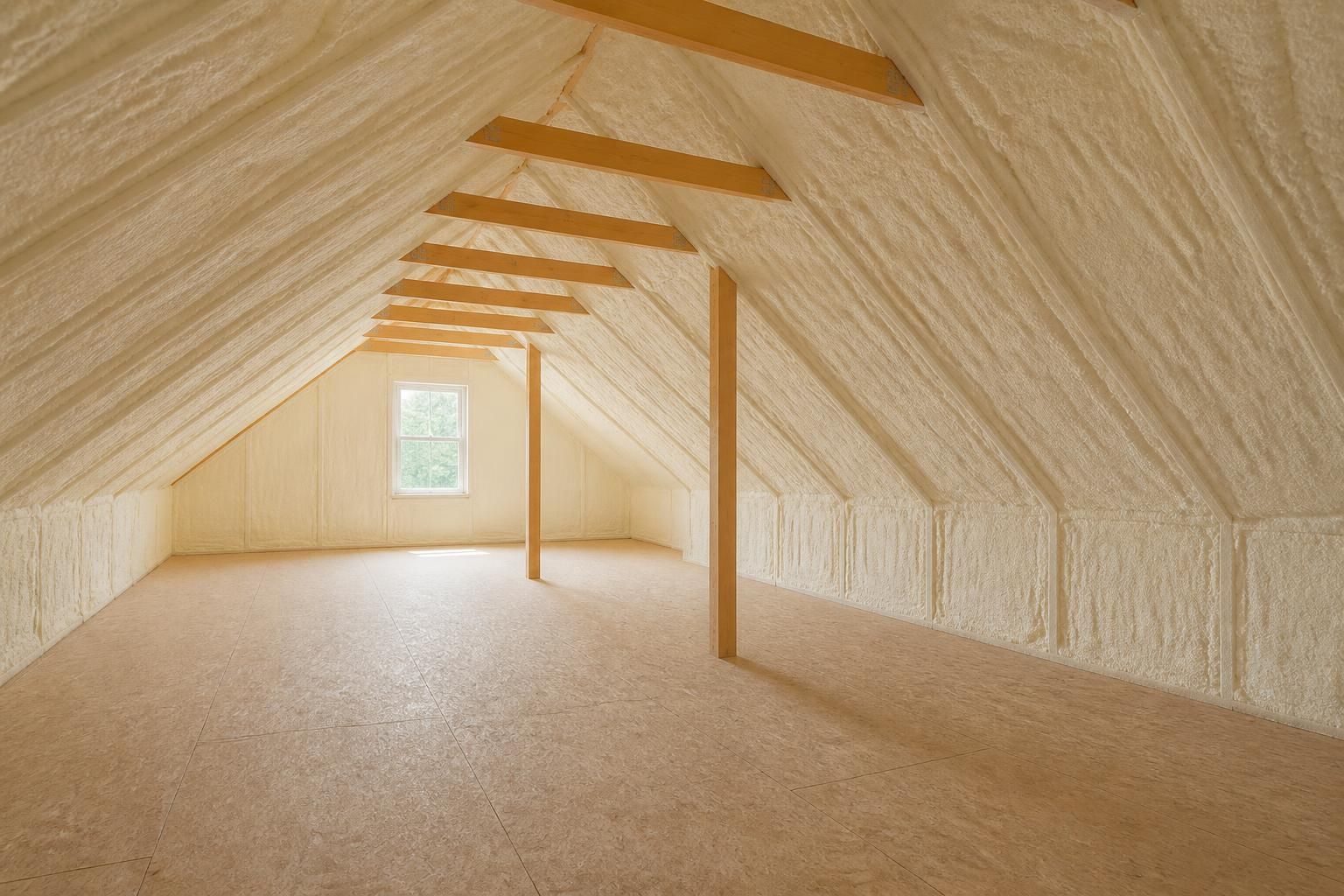
Open-cell spray polyurethane foam and closed-cell spray polyurethane foam can be useful where air sealing is critical, such as rim/band joists, sill plates, and certain wall or roof transitions. EPS and XPS may be used in selected basement or foundation applications where rigid board insulation is needed. Product selection should follow the assembly, moisture conditions, and Ontario Building Code requirements that apply to air barriers, vapour control, and fire protection detailing.
Ice dams usually begin when heat escapes through the upper envelope, warms the underside of the roof deck, and melts snow above. The meltwater runs downward until it reaches a colder roof edge and refreezes. That ridge of ice can trap water and force it back under shingles, causing leaks at the eaves or wall line.
Homes with cold rooms, drafty ceilings, or visible frost often have one or more of these conditions:
Correcting the heat flow first is essential. If the attic stays colder, snow on the roof is less likely to melt from below, which helps reduce the conditions that lead to ice damming.
Ontario homeowners may have access to incentive programs that can help offset eligible insulation and air-sealing work, though eligibility and amounts depend on the home, the starting condition, and current program rules. BetterHomes London details should always be checked against currently verified information before assuming a pathway applies.
The current Home Renovation Savings program includes a standalone attic-insulation pathway that may offer 50% of eligible project cost up to $1,250, depending on starting R-value and program requirements. The bundled energy-assessment pathway currently offers incentives including up to $1,500 for attic insulation, $3,600 for exterior walls, $2,300 for foundation insulation, $300 for exposed floors, $250 for air sealing, plus a $600 home-energy-assessment rebate and potential bundle incentives. These figures can change, and rebate approval is never guaranteed.
Qualifying Ontario households may receive no-cost attic or basement insulation and draft-proofing measures through the Energy Affordability Program, subject to household, home, and heating eligibility. If you are exploring this path, it is worth confirming the latest requirements before scheduling work.
We serve residential and commercial properties throughout London, Ontario and surrounding Middlesex County communities, including St. Thomas, Strathroy, Woodstock, Ingersoll, Dorchester, Komoka, Tillsonburg, and Aylmer. Whether the issue is attic frost, condensation at the roof deck, or ice dams along the eaves, the same building-envelope principles apply.
For London, ON N5Z 1R8 homes, attic symptoms often tie back to the same key details: ceiling-plane air sealing, proper insulation depth, vent channel clearance, and moisture control at cold surfaces. Addressing those together gives the attic a better chance of staying dry through winter swings and thaw cycles.
Frost on nails usually happens when moist indoor air leaks into the attic and condenses on cold metal fasteners. The nails cool quickly, so frost appears there before it becomes obvious on other surfaces.
More insulation can help reduce heat loss, but it does not solve air leakage on its own. Ice dams are often driven by both insulation gaps and ceiling-plane bypasses, so air sealing is usually part of the fix.
A damp smell can point to condensation on roof sheathing, moisture in the insulation, or repeated freeze-thaw cycles in the attic. A moisture meter and visual inspection can help narrow down the source.
Soffit baffles keep insulation from blocking the intake path at the eaves. That allows outside air to move through the attic as intended while preserving insulation depth over the ceiling plane.
Common leak points include the attic hatch, top plates, plumbing stacks, wiring penetrations, bath fan housings, and transitions around kneewalls or dropped ceilings. Those areas can move warm air into the attic even when the rest of the home feels comfortable.
Yes, because building-envelope leakage can create a stack effect that pulls indoor air upward through the home. Sealing rim/band joists, sill plates, and other leakage points can reduce that upward air movement and lower attic moisture risk.
If frost, condensation, or ice dams are showing up above your ceiling, the next step is to find the path that is carrying heat and moisture into the attic. London Insulation Company can assess the assembly, identify the leakage points, and recommend the insulation and air-sealing work that fits the home, not just the symptom.
Reach out to London Insulation Company at 413 Hamilton Rd, London, ON N5Z 1R8, by phone at +16477005472, or by email at [email protected] to discuss attic frost, condensation, and ice dam solutions for your property.
Start Here
Tell us about the rooms, drafts, cold spots, condensation, or attic issues you are seeing. We will help you understand which insulation, air-sealing, or moisture-control approach best fits the building and the conditions in Southwestern Ontario.