
Cold rooms, drafty rim joists, and attic frost usually point to one thing: the building envelope is leaking heat and air. When the ceiling plane, framed cavities, top plates, or penetrations are not sealed well, heat moves by conduction and moving air carries moisture toward colder surfaces. That can leave a London, ON N5Z 1R8 home with uneven temperatures, higher heating demand, and condensation where you do not want it.
London Insulation Company helps homeowners and property managers choose spray foam insulation where it makes the most sense for thermal control, air sealing, and moisture management. We look at the assembly first, then recommend open-cell or closed-cell spray polyurethane foam where it can improve the air barrier, reduce thermal bridging, and support the right R-value for the space.
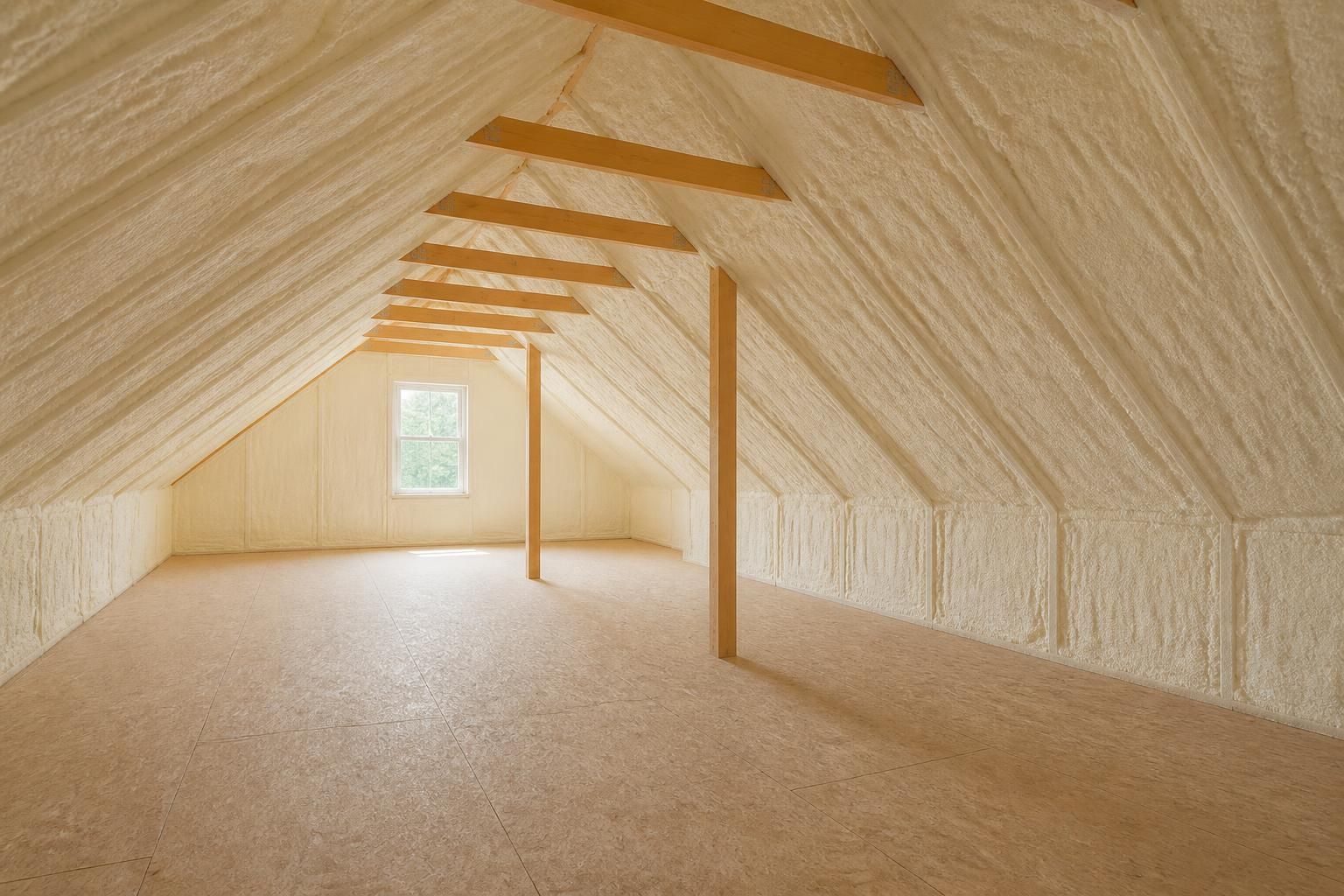
Spray foam is often used where standard fibreglass batts or loose-fill products cannot control air leakage well enough. In Southwestern Ontario homes, that often means areas with small gaps, irregular framing, or cold surfaces that collect moisture. The material expands into cracks and around obstructions, helping reduce the air leakage that drives drafty rooms and heat loss.
We commonly use spray foam around:
For some spaces, spray foam is the primary insulation. For others, it is part of a larger assembly that may also include fibreglass batts, mineral wool, or rigid foam such as EPS or XPS, depending on the wall or foundation detail.
Open-cell and closed-cell spray polyurethane foam behave differently, so the right choice depends on moisture exposure, thickness limits, and the job location. We consider the assembly, the temperature difference across it, and how the vapour control layer should work with the rest of the wall or roof.
Open-cell foam is lighter and expands more, which helps fill difficult cavities and seal small air paths. It can be useful in interior wall and roof assemblies where the goal is air sealing and thermal resistance without building a very rigid layer. Because it is more vapour-open than closed-cell foam, the surrounding assembly still needs to be planned around dew point and condensation risk.
Closed-cell foam has a higher density and lower permeability. That makes it a strong option where moisture resistance, added rigidity, and higher R-value per inch matter, such as foundation walls, rim joists, garage surfaces, or certain roof details. In cold weather, that extra resistance can help keep the interior side of the assembly warmer and reduce condensation risk on colder surfaces.
Choosing between the two is not about what sounds stronger. It is about how the wall, roof sheathing, or concrete foundation wall will handle heat flow, vapour movement, and air leakage over time.
Spray foam insulation is often selected after a closer look with thermal imaging, moisture meters, and blower-door testing. Those tools help identify where heat is escaping and where outside air is entering, which is useful when a homeowner is dealing with one room that never feels comfortable.
Unsealed rim and band joists can be one of the coldest spots in a basement. Spray foam helps air seal the sill plate area and reduce the conductive losses that make floors above feel chilly.
At attic hatches, top plates, plumbing stacks, and electrical penetrations, foam can cut leakage at the ceiling plane. That helps reduce heat escaping into the attic and can lower the risk of frost or moisture at the roof sheathing.
Foundation walls often stay cold through winter. Closed-cell foam or a planned hybrid assembly can help manage dew point concerns and reduce condensation on concrete foundation walls.
Attached garages can transmit cold and odours into the house through framed cavities and shared surfaces. Spray foam can help tighten these assemblies where the design calls for it.
Low-clearance spaces with damp air and exposed framing benefit from tighter air control. Spray foam can help when the goal is to reduce drafts and manage moisture movement through the floor assembly.
London Insulation Company starts with the building envelope, not the product label. That means looking at the attic, basement, wall cavities, and air-barrier continuity before deciding where spray foam belongs. The goal is to improve comfort and moisture control without creating a mismatch between insulation type, vapour control, and the rest of the assembly.
A typical visit may include:
We look for gaps, damaged insulation, exposed penetrations, and areas where thermal bridging is likely.
Thermal imaging and blower-door testing can show where air is moving through the envelope and where ACH50 may be elevated because of leaks.
Open-cell or closed-cell foam is selected based on location, thickness, moisture exposure, and the existing air-barrier setup.
Surfaces need to be clear and dry enough for adhesion, especially around sill plates, roof sheathing, and concrete foundation walls.
Foam is installed to target the cavity, then trimmed where needed so the final assembly can accept the next layer or finish material.
This process matters because a good insulation result is about more than thickness. The total assembly has to manage heat, air, and vapour together.
Many homeowners first notice a spray foam issue as visible condensation, attic frost, or musty air near the basement. Those symptoms often appear when warm indoor air reaches a cold surface and the dew point is reached inside the assembly. Air leakage is a major driver because moving air carries moisture much faster than vapour diffusion alone.
Spray foam can help by limiting air movement and shifting where the temperature drop occurs inside the wall or roof assembly. That is why it is often used at roof sheathing edges, rim joists, sill plates, and concrete foundation walls where condensation risk is higher. The right vapour strategy still matters, especially in Ontario Building Code related assemblies where insulation, air barrier continuity, and vapour control need to work together.
When attic frost shows up, the fix is rarely one product alone. The attic hatch, top plates, soffit baffles, penetrations, and ceiling plane all need to be checked so warm indoor air is not reaching cold roof surfaces.
Ontario programs can change, and eligibility depends on the home, the starting condition, the work scope, and program rules at the time of application. We can point homeowners toward program information, but rebate approval and incentive amounts are not guaranteed.
Home Renovation Savings currently includes a standalone attic-insulation pathway offering 50% of eligible project cost up to $1,250, depending on the starting R-value and program requirements. The bundled energy-assessment pathway currently offers incentives that may include up to $1,500 for attic insulation, $3,600 for exterior walls, $2,300 for foundation insulation, $300 for exposed floors, $250 for air sealing, plus a $600 home-energy-assessment rebate and potential bundle incentives.
Energy Affordability Program may provide qualifying Ontario households with no-cost attic or basement insulation and draft-proofing measures, subject to household, home, and heating eligibility.
BetterHomes London should be reviewed only against currently verified program and financing details before any decision is made.
Spray foam is usually chosen to solve specific comfort and moisture complaints, not as a generic upgrade. Homeowners often call after noticing one or more of these:
In many cases, spray foam is most effective when paired with air sealing and a broader insulation plan. That may mean adding blown-in cellulose to an attic, using fibreglass batts in framed cavities, or combining rigid EPS or XPS with a basement wall assembly.
We provide spray foam insulation work from our London base at 413 Hamilton Rd, London, ON N5Z 1R8, throughout London and nearby Middlesex County communities. That includes St. Thomas, Strathroy, Woodstock, Ingersoll, Dorchester, Komoka, Tillsonburg, and Aylmer.
If your house has a cold basement, a leaky attic transition, or a garage that never matches the rest of the home, spray foam may be the right part of the fix. The key is matching the foam type and thickness to the assembly, not just filling a cavity.
It helps most where air leakage and thermal bridging are hard to control, such as rim joists, sill plates, attic transitions, crawl spaces, and irregular cavities.
It can help when frost is driven by warm air leaking through the ceiling plane, but the attic hatch, penetrations, soffit baffles, and roof assembly still need to be evaluated.
We look at moisture exposure, cavity depth, desired air sealing, vapour control, and whether the surface is wood framing, roof sheathing, or concrete foundation wall.
Yes. Many assemblies use spray foam for air sealing at critical points and another insulation type for broader cavity or attic coverage.
Because moisture often follows air leaks. If warm indoor air reaches a cold surface inside the assembly, condensation can return until the leakage path and temperature profile are addressed together.
Yes. We review the space, identify leakage paths, and consider thermal imaging, moisture readings, and blower-door results where they are useful for the diagnosis.
If you want spray foam insulation for a London, ON N5Z 1R8 home that feels colder than it should, London Insulation Company can help you narrow the cause and choose the right assembly approach.
Start Here
Tell us about the rooms, drafts, cold spots, condensation, or attic issues you are seeing. We will help you understand which insulation, air-sealing, or moisture-control approach best fits the building and the conditions in Southwestern Ontario.